
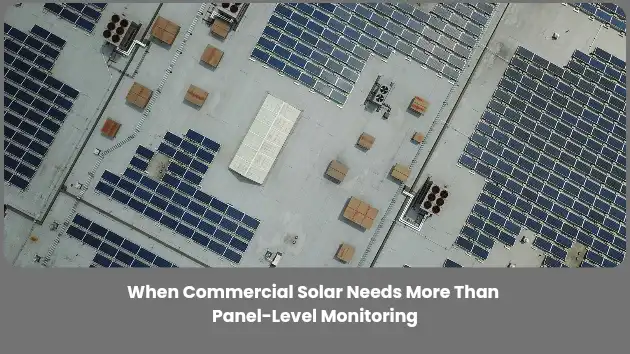

A commercial roof can hold a lot of solar. It can also hide a lot of design problems: HVAC shadows, tenant load changes, demand charges, limited switchgear space, and a CFO who wants predictable savings instead of a science project.
Micro inverter discussions often focus on panel-level monitoring. For commercial and industrial sites, that is only one part of the decision.
The Commercial Solar Problem Is Different
A house usually wants lower bills and backup for essential loads. A commercial site may care about demand charges, peak shaving, uptime, tenant billing, ESG reporting, and future battery storage.
The International Energy Agency has reported that solar PV continues to be a major driver of new power capacity worldwide. In commercial settings, the next question is how that solar interacts with business operations.
Panel-level monitoring can help when a roof has many obstructions or when maintenance teams need granular visibility. But on larger systems, inverter architecture, communications, and storage readiness can matter even more.
Why Battery Readiness Changes the Inverter Conversation
Many businesses install solar first and think about batteries later. That can work, but it may limit options if the original system was not designed for storage.
A commercial battery can help reduce peak demand, support critical operations, and improve use of on-site solar. It can also require space, controls, safety planning, and a clear interconnection strategy.
Sigenergy’sC&I inverter with a battery port is designed to connect with modular business energy storage, according to Sigenergy’s product information. That matters for sites that want solar now but do not want storage to become a full redesign later.
Monitoring Should Match the Maintenance Team
Granular data is valuable only when someone can use it. A facility manager does not need a dashboard full of decorative charts. The team needs to know which equipment is underperforming, whether export limits are being met, and whether storage or loads are behaving as expected.
For a commercial system, useful monitoring often includes:
- Inverter-level status
- Alarm history
- Export control behavior
- Battery readiness or state of charge
- Load and demand trends
If panel-level electronics are used, that data should fit into the broader operations workflow rather than living in a separate silo.
Do Not Design Only for Year One
Commercial energy use changes. A warehouse adds EV forklifts. A retail site installs fast chargers. A factory adds a second shift. A school district wants backup for cooling centers.
A solar system that looked perfect at commissioning may feel undersized or inflexible later.
That is why a commercial proposal should explain expansion paths. Can batteries be added? Can multiple inverters operate together? Can the site manage export limits? Can backup be prioritized for specific loads?
The business energy gateway is another relevant reference for businesses comparing panel-level solar designs against a storage-ready C&I architecture.
For commercial rooftops, the best solar design is not always the one with the most detailed panel map. It is the one that keeps the business flexible as energy needs change.